Classification Algorithms Explained – Learn Machine Learning with Python
Published: 22 Oct, 2026 | Author: CCI Admin | Category: Machine Learning / Python
Machine Learning helps computers learn patterns from data and make predictions. One important task is Classification, where a model predicts a category such as spam or not spam, approved or rejected, or pass or fail.
In this guide from CCI Computer Education, Pudukkottai, you will learn popular classification algorithms and build a simple classification model using Python.
1. What Is Classification in Machine Learning?
Classification is a supervised Machine Learning technique that learns from labelled data and predicts a category for new data.
Examples of classification include:
- Email classification: Spam or Not Spam.
- Loan prediction: Approved or Rejected.
- Feedback analysis: Positive, Neutral, or Negative.
- Image classification: Cat, Dog, or Other Objects.
2. How Do Classification Algorithms Work?
A classification model generally follows these steps:
- Collect labelled training data.
- Prepare the data and select useful features.
- Split the dataset into training and testing sets.
- Choose a classification algorithm.
- Train the model using training data.
- Predict classes for new data.
- Evaluate the model's performance.
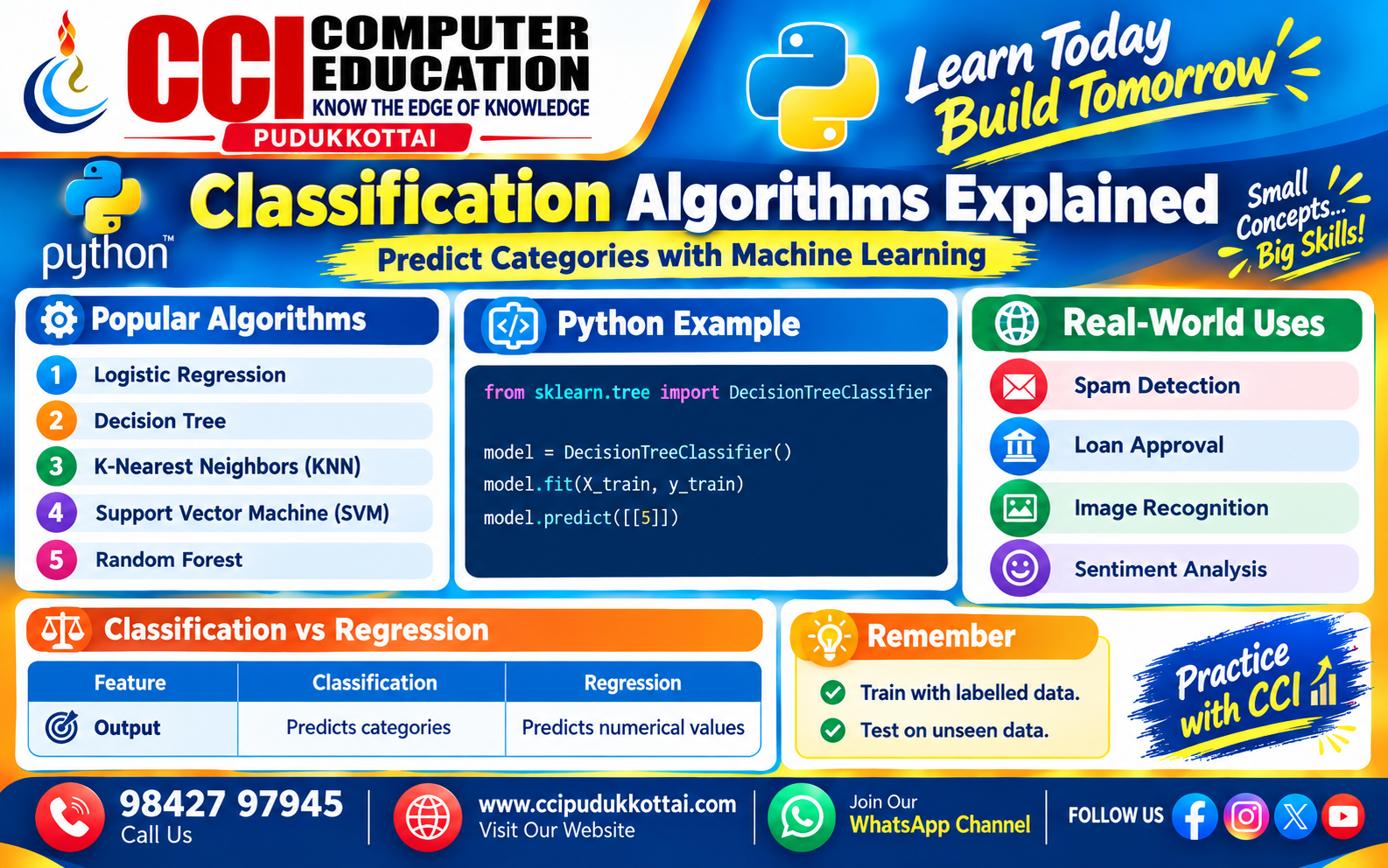
3. Popular Classification Algorithms
| Algorithm | How It Works | Example |
|---|---|---|
| Logistic Regression | Estimates the probability of a class. | Spam detection. |
| Decision Tree | Makes decisions using feature-based rules. | Loan classification. |
| K-Nearest Neighbors (KNN) | Uses nearby training examples to predict a class. | Classifying similar records. |
| Support Vector Machine (SVM) | Finds a boundary that separates classes. | Text classification. |
| Random Forest | Combines predictions from multiple decision trees. | Customer classification. |
4. Install the Required Python Library
We will use scikit-learn to build our classification model.
pip install scikit-learnRun this command in your terminal or command prompt.
5. Simple Classification Example in Python
Let us create a simple model that predicts whether a sample student belongs to the "Pass" or "Needs More Practice" category based on study hours. This is only an illustrative dataset for learning.
from sklearn.tree import DecisionTreeClassifier

# Input feature: hours studied
hours = [[1], [2], [3], [4], [5], [6]]

# Target class labels
results = [
    "Needs More Practice",
    "Needs More Practice",
    "Needs More Practice",
    "Pass",
    "Pass",
    "Pass"
]

# Create the model
model = DecisionTreeClassifier(random_state=42)

# Train the model
model.fit(hours, results)

# Predict the result for 5 hours of study
prediction = model.predict([[5]])

print("Predicted Result:", prediction[0])
Output:
Predicted Result: PassThe model learns patterns from the sample data and predicts a category for new input. Real student performance depends on many factors, so this small example should not be used as an actual grading system.
6. Understanding the Python Code
| Code | Purpose |
|---|---|
DecisionTreeClassifier() |
Creates a classification model. |
model.fit() |
Trains the model using labelled data. |
model.predict() |
Predicts a class for new input data. |
random_state=42 |
Helps make applicable random choices reproducible. |
7. Classification vs Regression
| Feature | Classification | Regression |
|---|---|---|
| Output | Category or class. | Numerical value. |
| Example | Spam or Not Spam. | Predicting house prices. |
| Algorithms | Decision Tree, KNN, Logistic Regression. | Linear Regression, Decision Tree Regressor. |
8. How Is a Classification Model Evaluated?
Accuracy measures the proportion of predictions that are correct. Precision, recall, F1-score, and a confusion matrix can also help evaluate classification models.
from sklearn.metrics import accuracy_score

actual = [
    "Pass",
    "Needs More Practice",
    "Pass",
    "Pass"
]

predicted = [
    "Pass",
    "Needs More Practice",
    "Needs More Practice",
    "Pass"
]

accuracy = accuracy_score(actual, predicted)

print("Accuracy:", accuracy)
Output:
Accuracy: 0.75Three out of four predictions are correct, giving an accuracy of 75%. In a real project, evaluate the model on separate test data that was not used during training.
9. Advantages of Classification Algorithms
- Predict categories from labelled data.
- Useful for spam filtering and document classification.
- Offer several algorithms for different types of datasets.
- Can be evaluated using accuracy, precision, and recall.
- Support practical Machine Learning projects.
10. Limitations of Classification Algorithms
- Poor-quality training data can produce unreliable predictions.
- Some algorithms require feature scaling or parameter tuning.
- A model may perform well on training data but poorly on new data.
- Accuracy can be misleading when classes are unbalanced.
11. Faculty Tip
At CCI Computer Education, students can create a small labelled dataset and experiment with Decision Tree and KNN algorithms. Encourage them to compare predictions and discuss why training data quality and testing are important.
12. Practice Task for Students
- Install scikit-learn using pip.
- Create a dataset with input features and class labels.
- Train a Decision Tree model using
model.fit(). - Predict a class using
model.predict(). - Try KNN and compare the results.
- Calculate accuracy using actual and predicted labels.
13. Frequently Asked Questions (FAQs)
1. What is classification in Machine Learning?
Classification is a supervised learning task in which a model predicts categories using patterns learned from labelled data.
2. What are popular classification algorithms?
Popular algorithms include Logistic Regression, Decision Trees, KNN, Support Vector Machines, and Random Forest.
3. Which Python library is used for classification?
Scikit-learn provides many classification algorithms and evaluation tools for Python.
4. What is the difference between classification and regression?
Classification predicts categories, while regression predicts numerical values such as prices or temperatures.
5. What is accuracy?
Accuracy is the proportion of predictions that match the correct labels. Precision and recall can provide additional information about model performance.
Conclusion
Classification is an important Machine Learning technique used to predict categories from data. By learning algorithms such as Decision Trees, KNN, and Logistic Regression, students can begin building practical Python projects.
Practise the examples and continue developing your Machine Learning skills with CCI Computer Education, Pudukkottai.
What to Learn Next
- Logistic Regression with Python
- Confusion Matrix, Precision, and Recall
- Train-Test Split in Machine Learning
Related CCI Blogs
- Machine Learning Explained with Real-World Examples
- Supervised vs Unsupervised Learning
- How a Loan Approval Prediction System Works
Learn Python and Machine Learning with CCI Computer Education
Want to learn Python programming and Machine Learning through practical examples and projects? Join CCI Computer Education, Pudukkottai, and develop skills for your technology career.
Start your AI & ML journey with CCI 👆Click here
Call: 98427 97945
Website:
www.ccipudukkottai.com
WhatsApp Channel: Follow CCI Computer Education
CCI Computer Education – Learn Today, Build Tomorrow.