Machine Learning Explained with Real-World Examples – A Practical Guide for Students
Published: 19 Sep, 2026 | Author: CCI Admin | Category: AI / Machine Learning
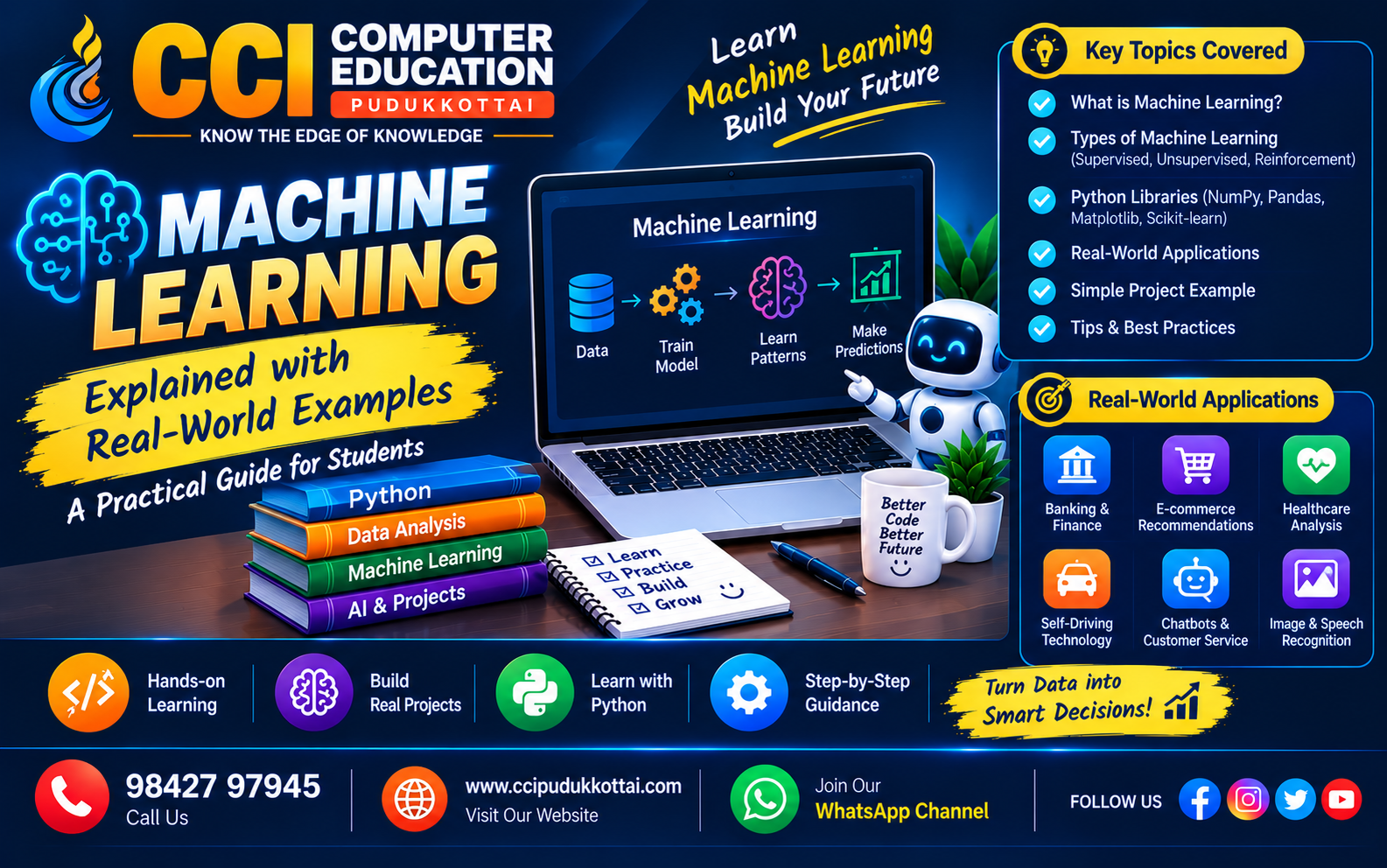
Machine Learning is one of the most important technologies in Artificial Intelligence. It allows computers to learn patterns from data and make predictions or decisions without being explicitly programmed for every situation.
At CCI Computer Education, Pudukkottai, students can understand Machine Learning step by step through Python programming, practical examples, and real-world projects.
What is Machine Learning?
Machine Learning is a branch of Artificial Intelligence that enables computers to learn from data and improve their predictions or decisions based on the information provided to them.
Instead of writing a separate rule for every situation, we provide data to a Machine Learning algorithm and allow the model to identify useful patterns.
Simple Real-World Problem
Imagine a bank wants to predict whether a customer is likely to repay a loan.
The system can learn from previous customer information such as income, loan amount, credit history, and repayment records.
After learning from existing data, the Machine Learning model can make a prediction for a new customer.
How Machine Learning Works
- Collect data
- Clean and prepare the data
- Select useful features
- Choose a Machine Learning algorithm
- Train the model
- Test the model
- Evaluate the results
- Use the model for prediction
Types of Machine Learning
1. Supervised Learning
In supervised learning, the model learns from data that already contains known answers or labels.
Example: Predicting whether a loan application will be Approved or Rejected.
2. Unsupervised Learning
In unsupervised learning, the data does not contain predefined labels. The algorithm attempts to discover patterns or groups within the data.
Example: Grouping customers based on their purchasing behavior.
3. Reinforcement Learning
Reinforcement Learning allows an agent to learn through actions, rewards, and penalties.
Example: Training an AI system to play a game or control a robot.
Real-World Applications of Machine Learning
- Banking and fraud detection
- Online shopping recommendations
- Email spam detection
- Movie and music recommendations
- Healthcare data analysis
- Self-driving technology
- Customer service chatbots
- Image and speech recognition
Machine Learning with Python
Python is widely used for Machine Learning because it provides many useful libraries and frameworks.
- NumPy – Numerical calculations
- Pandas – Data processing and analysis
- Matplotlib – Data visualization
- Scikit-learn – Machine Learning algorithms
Simple Machine Learning Workflow
Data
  ↓
Data Cleaning
  ↓
Feature Selection
  ↓
Train Model
  ↓
Test Model
  ↓
Evaluate
  ↓
Prediction
Simple Python Example
from sklearn.tree import DecisionTreeClassifier

X = [
    [25, 30000],
    [35, 50000],
    [45, 70000],
    [50, 90000]
]

y = ["Rejected", "Approved", "Approved", "Approved"]

model = DecisionTreeClassifier()

model.fit(X, y)

result = model.predict([[40, 60000]])

print(result)
This simple example demonstrates the basic idea of training a model with existing data and using it to make a prediction for new data.
Real-World Example – Loan Prediction
A Loan Approval Prediction System can use Machine Learning to analyze customer information and predict whether a loan application may be approved or rejected.
A student project can combine Python, Pandas, Scikit-learn, Flask, HTML, CSS, and JavaScript to create a complete Machine Learning web application.
This type of project helps students understand how Machine Learning can be connected with real-world software applications.
Common Mistakes Beginners Make
- Using poor-quality or incomplete data
- Training a model without understanding the dataset
- Using too many unnecessary features
- Testing the model only with training data
- Choosing an algorithm without understanding the problem
- Assuming high accuracy always means a good model
CCI Faculty Tip
Don't start Machine Learning by memorizing algorithms. First understand the problem, dataset, features, labels, and workflow. Then practice one algorithm at a time using small Python projects.
Practice Task for Students
Create a small dataset containing:
- Student Name
- Study Hours
- Attendance
- Previous Marks
- Result
Try to understand how these features could be used to predict whether a student may pass or fail.
Machine Learning vs Traditional Programming
| Traditional Programming | Machine Learning |
|---|---|
| Rules are explicitly written by the programmer. | The model learns patterns from data. |
| Input + Rules → Output | Data + Expected Results → Model |
| Suitable for clearly defined rules. | Useful for pattern-based problems. |
Frequently Asked Questions
1. What is Machine Learning?
Machine Learning is a branch of AI that enables computers to learn patterns from data and make predictions or decisions.
2. Is Python required for Machine Learning?
Python is not the only option, but it is widely used because of its powerful libraries and beginner-friendly syntax.
3. What should I learn before Machine Learning?
Students should have basic Python knowledge and understand variables, functions, lists, dictionaries, and basic mathematics.
4. What is a Machine Learning model?
A Machine Learning model is a trained computational system that learns patterns from data and can be used to make predictions or decisions.
5. Can students build Machine Learning projects?
Yes. Students can begin with small projects such as student performance prediction, house price prediction, spam detection, and loan prediction.
Learn Machine Learning at CCI Computer Education
At CCI Computer Education, Pudukkottai, students can gradually move from Python programming to Data Science, Machine Learning, AI tools, and practical project development.
Practical projects help students understand how programming, data, and Machine Learning can work together to solve real-world problems.
Conclusion
Machine Learning is an important part of modern Artificial Intelligence. It helps computers identify patterns from data and use those patterns to make predictions or decisions.
Start with Python, understand data, practice simple algorithms, and gradually build real-world Machine Learning projects.
Next Learning Path
In the next AI tutorial, we will explore Supervised vs Unsupervised Learning with simple examples.
Related CCI Blogs
Contact CCI Computer Education – Pudukkottai
Want to learn Python, Artificial Intelligence, and Machine Learning through practical training?
Call: 98427 97945 | Website: ccipudukkottai.com
WhatsApp Channel: Join Now
Share: Facebook | WhatsApp | Twitter