Java Encapsulation Explained with Examples
Published: 13 November 2026 | Author: CCI Admin | Category: Java
Java is an object-oriented programming language that provides several important concepts to develop secure, reusable, and maintainable applications. One of the most important principles of Object-Oriented Programming (OOP) is Encapsulation.
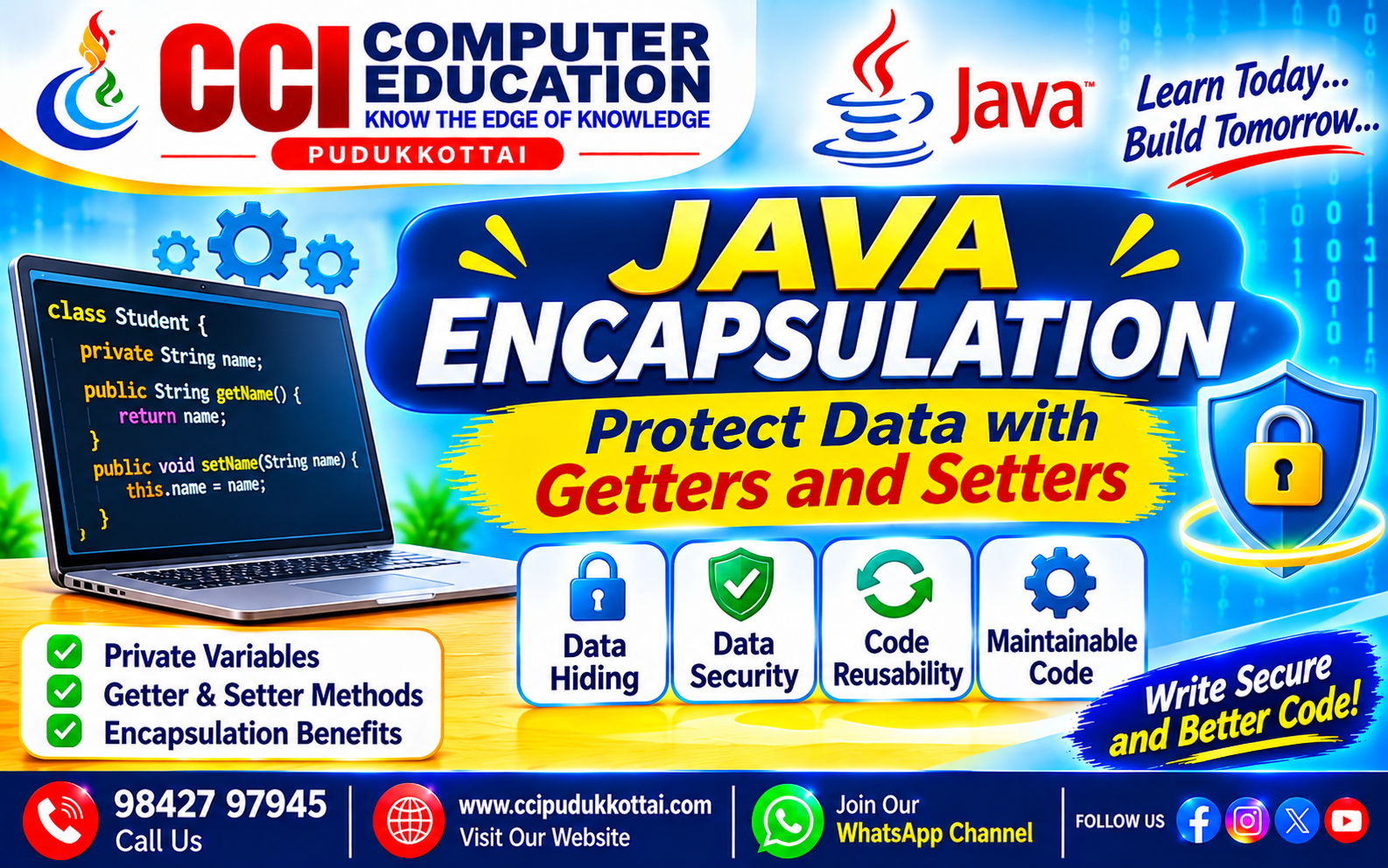
Encapsulation helps protect data by combining variables and methods inside a class and restricting direct access to the internal data. In this blog, we will learn Java Encapsulation with simple examples and understand how getters and setters are used in real-world applications.
1. What is Encapsulation in Java?
Encapsulation is the process of wrapping data (variables) and methods into a single unit called a class. It also helps achieve data hiding by restricting direct access to class variables.
In Java, encapsulation is commonly implemented using:
- Private variables
- Public getter methods
- Public setter methods
This approach allows controlled access to the data stored inside a class.
2. Why is Encapsulation Important?
Encapsulation is important because it protects data and improves the organization of Java programs.
Benefits of Encapsulation:
- Data Hiding: Prevents direct access to private variables.
- Data Security: Allows controlled modification of data.
- Code Reusability: Helps organize code into reusable classes.
- Maintainability: Makes programs easier to update and manage.
- Validation: Allows developers to validate values before updating variables.
3. How to Achieve Encapsulation in Java?
We can achieve encapsulation in Java by following these steps:
- Declare class variables as private.
- Create public getter methods to read variable values.
- Create public setter methods to update variable values.
- Access the variables through these methods instead of accessing them directly.
4. Java Encapsulation Example
Let's understand encapsulation using a simple Student class.
Example Program:
class Student {

    private String name;
    private int age;

    public void setName(String name) {
        this.name = name;
    }

    public String getName() {
        return name;
    }

    public void setAge(int age) {
        this.age = age;
    }

    public int getAge() {
        return age;
    }
}

public class Main {
    public static void main(String[] args) {

        Student s = new Student();

        s.setName("Arun");
        s.setAge(20);

        System.out.println("Name: " + s.getName());
        System.out.println("Age: " + s.getAge());
    }
}
Output:
Name: Arun
Age: 20
Explanation:
- The Student class contains private variables name and age.
- The setName() and setAge() methods update the values.
- The getName() and getAge() methods retrieve the values.
- The main() method accesses the data through public methods.
5. What are Getter and Setter Methods in Java?
Getter and setter methods are used to access and modify private variables in a class.
Getter Method
A getter method is used to retrieve the value of a private variable.
public String getName() {
    return name;
}
Setter Method
A setter method is used to assign or update the value of a private variable.
public void setName(String name) {
    this.name = name;
}
6. Difference Between Encapsulation and Data Hiding
Encapsulation and data hiding are related concepts, but they are not exactly the same.
| Encapsulation | Data Hiding |
|---|---|
| Combines data and methods into a single unit. | Restricts direct access to internal data. |
| Focuses on organizing and controlling data. | Focuses on protecting data. |
| Implemented using classes and access control. | Achieved using access modifiers such as private. |
7. Real-Life Example of Encapsulation
A bank account is a good real-life example of encapsulation.
When a customer uses a banking application, they cannot directly modify the account balance stored inside the system. Instead, they perform operations such as depositing or withdrawing money through authorized methods.
Example:
class BankAccount {

    private double balance = 5000;

    public double getBalance() {
        return balance;
    }

    public void deposit(double amount) {
        if (amount > 0) {
            balance += amount;
        }
    }
}
In this example, the balance variable is private. The deposit() method provides controlled access to increase the account balance.
8. Frequently Asked Questions (FAQ)
1. What is encapsulation in Java?
Encapsulation is an OOP concept that combines variables and methods inside a class and helps restrict direct access to internal data.
2. How is encapsulation achieved in Java?
Encapsulation is commonly achieved by declaring variables as private and providing public getter and setter methods.
3. What is the purpose of private variables?
Private variables restrict direct access from outside the class and help protect the internal data.
4. What is the difference between getter and setter methods?
A getter method retrieves a variable's value, whereas a setter method updates its value.
5. Is encapsulation an OOP principle?
Yes. Encapsulation is one of the four main principles of Object-Oriented Programming, along with inheritance, polymorphism, and abstraction.
6. Can we achieve encapsulation without setter methods?
Yes. A class can provide only getter methods or other controlled operations when its data should not be directly modified.
9. Practice Questions for Students
Try these questions to test your understanding of Java encapsulation.
- Define encapsulation in Java.
- Why are variables declared as private?
- What is a getter method?
- What is a setter method?
- Write a Java program using encapsulation.
- Explain the difference between encapsulation and data hiding.
Conclusion
Encapsulation is an important concept in Java programming that helps protect data, improve code organization, and provide controlled access to variables.
By using private variables along with getter and setter methods, developers can create secure, flexible, and maintainable applications.
Learn Java OOP concepts step by step and build strong programming skills for your future IT career!
What to Learn Next?
- Java Inheritance Explained with Examples
- Java Polymorphism Explained
- Java Abstraction with Practical Examples
- Java Classes and Objects
- Four Principles of Object-Oriented Programming
Related CCI Blogs
Learn Java Programming with CCI Computer Education
Want to learn Java programming and develop real-world applications? CCI Computer Education – Pudukkottai provides practical computer education and programming training to help students develop industry-relevant technical skills.
Learn Java, Python, C, C++, Web Development, SQL, and other career-oriented technologies through practical training and project-based learning.
Explore CCI Computer Education Courses In Software Development
Contact CCI Computer Education – Pudukkottai
Interested in learning Java programming? Contact CCI Computer Education for course details and upcoming batches.
Call: 98427 97945 | Website: www.ccipudukkottai.com
WhatsApp Channel: Join CCI WhatsApp Channel
CCI Computer Education – Learn Today, Build Tomorrow.