Java Constructors Explained with Simple Examples
Published: 15 Sep, 2026 | Author: CCI Admin | Category: Java / Programming
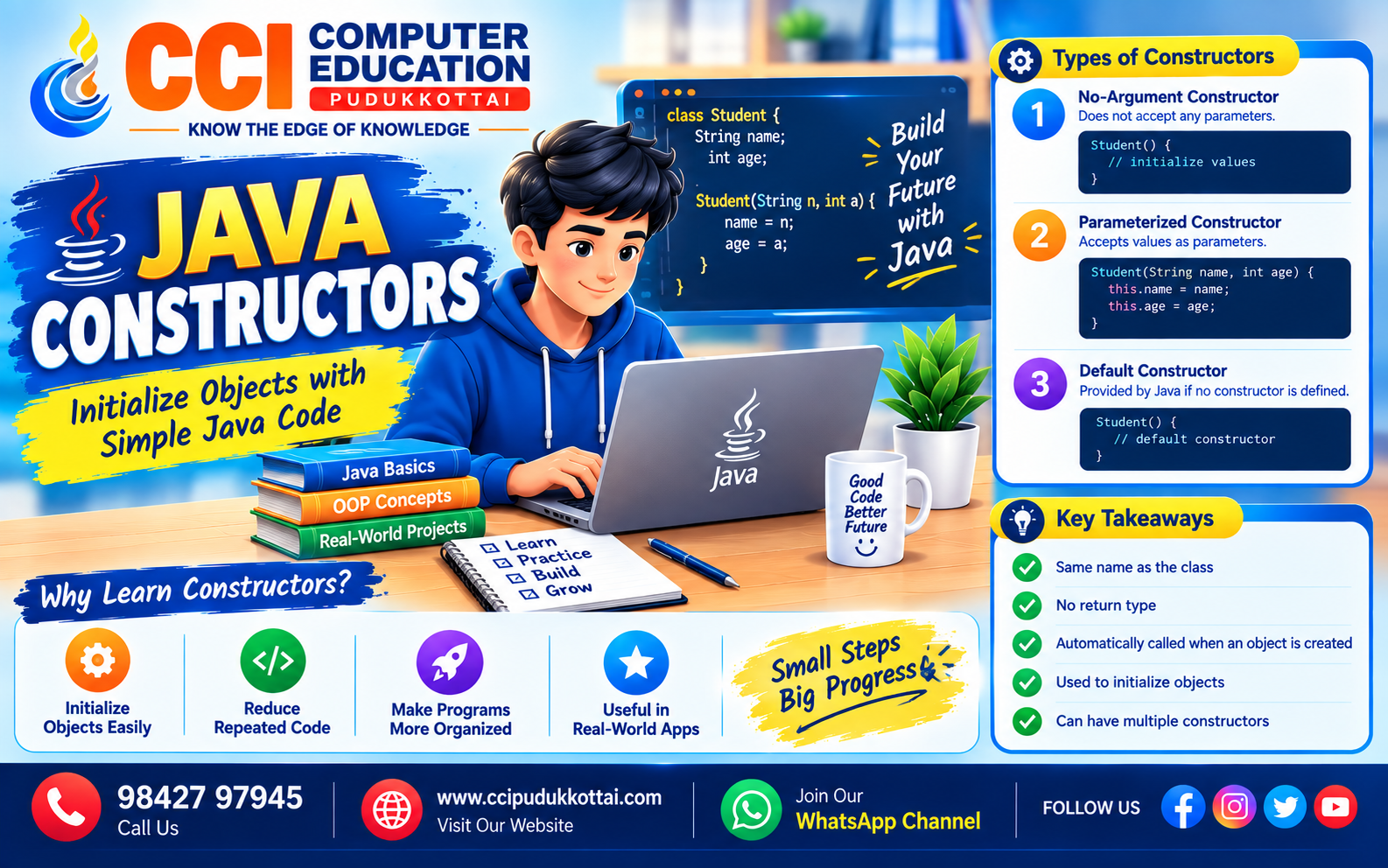
Constructors are one of the most important concepts in Java Object-Oriented Programming. They are used to initialize objects when an object is created.
If you are learning Java classes and objects, understanding constructors is the next important step. At CCI Computer Education, Pudukkottai, students can learn Java concepts through simple explanations and practical coding examples.
What is a Constructor in Java?
A constructor is a special method-like block in Java that is automatically called when an object is created.
The main purpose of a constructor is to initialize the data members of an object.
A constructor has the same name as the class and does not have a return type.
Simple Constructor Example
class Student {

    String name;
    int age;

    Student() {
        name = "Arun";
        age = 20;
    }
}

public class Main {

    public static void main(String[] args) {

        Student s1 = new Student();

        System.out.println(s1.name);
        System.out.println(s1.age);
    }
}
When new Student() is executed, the Student constructor is automatically called and the values are assigned to the object.
Important Features of Constructors
- A constructor has the same name as the class.
- A constructor does not have a return type.
- It is automatically called when an object is created.
- Constructors are mainly used to initialize objects.
- A class can have more than one constructor.
Types of Constructors in Java
Commonly, beginners learn the following types of constructors:
- No-Argument Constructor
- Parameterized Constructor
- Default Constructor
1. No-Argument Constructor
A constructor that does not accept any parameters is called a no-argument constructor.
class Employee {

    Employee() {
        System.out.println("Employee object created");
    }
}

public class Main {

    public static void main(String[] args) {

        Employee e1 = new Employee();

    }
}
When the object e1 is created, the constructor runs automatically.
2. Parameterized Constructor
A parameterized constructor accepts values as parameters. It is useful when different objects need different initial values.
class Student {

    String name;
    int age;

    Student(String n, int a) {
        name = n;
        age = a;
    }
}

public class Main {

    public static void main(String[] args) {

        Student s1 = new Student("Arun", 20);
        Student s2 = new Student("Priya", 21);

        System.out.println(s1.name);
        System.out.println(s2.name);
    }
}
Here, the constructor receives the student's name and age while creating each object.
Constructor vs Method
| Constructor | Method |
|---|---|
| Same name as the class | Can have any valid name |
| No return type | Can have a return type |
| Used to initialize objects | Used to perform an action |
| Called when an object is created | Called explicitly |
Real-World Example
Imagine a student registration system. Whenever a new student is added, their name, age, and course can be initialized using a constructor.
class Student {

    String name;
    String course;

    Student(String name, String course) {

        this.name = name;
        this.course = course;
    }
}

public class Main {

    public static void main(String[] args) {

        Student student =
            new Student("Arun", "Java");

        System.out.println("Name: " + student.name);
        System.out.println("Course: " + student.course);
    }
}
This type of constructor is useful in real-world applications such as student management systems, employee management systems, banking systems, and e-commerce applications.
What is the this Keyword?
The this keyword refers to the current object. It is commonly used when constructor parameters and class variables have the same names.
class Student {

    String name;
    int age;

    Student(String name, int age) {

        this.name = name;
        this.age = age;
    }
}
Here, this.name refers to the class variable, while name refers to the constructor parameter.
Why Are Constructors Important?
- They initialize objects easily.
- They reduce repeated initialization code.
- They make programs easier to organize.
- They are widely used in real-world Java applications.
- They are important for Object-Oriented Programming.
Common Mistakes Beginners Make
- Giving a constructor a return type.
- Using a different name from the class name.
- Forgetting to create an object.
- Confusing constructors with methods.
- Not understanding the use of the this keyword.
Faculty Tip from CCI
Faculty Tip: When teaching constructors, first explain classes and objects. Then show how an object is created using new. Finally, introduce constructors as the mechanism that initializes the object.
Practice with simple examples such as Student, Employee, Car, and Bank Account before moving to constructor overloading.
Practice Task for Students
Create a Java class called Employee with the following properties:
- Employee Name
- Employee ID
- Salary
Create a parameterized constructor and initialize these values when the object is created.
Frequently Asked Questions
1. What is a constructor in Java?
A constructor is a special class member used to initialize an object when it is created.
2. Does a constructor have a return type?
No. A constructor does not have a return type, not even void.
3. When is a constructor called?
A constructor is automatically called when an object is created using the new keyword.
4. Can a class have multiple constructors?
Yes. A class can have multiple constructors with different parameter lists. This is called constructor overloading.
5. What is a parameterized constructor?
A parameterized constructor accepts one or more values that can be used to initialize an object.
Learn Java Through Practical Training at CCI
At CCI Computer Education, Pudukkottai, students can learn Java from basic programming concepts to Object-Oriented Programming and real-world application development.
Students can practice classes, objects, constructors, inheritance, polymorphism, abstraction, exception handling, collections, database connectivity, and projects.
Conclusion
Constructors are an essential part of Java Object-Oriented Programming. They make it easy to initialize objects when they are created.
Start with no-argument constructors, then practice parameterized constructors and constructor overloading. Regular coding practice will help you understand these concepts clearly.
Next Learning Path
After learning constructors, the next important Java topics are Constructor Overloading, this Keyword, Inheritance, Method Overloading, and Method Overriding.
Related CCI Blogs
Contact CCI Computer Education – Pudukkottai
Want to improve your Java and programming skills? Join CCI Computer Education, Pudukkottai and learn through practical, step-by-step training.
Call: 98427 97945 | Website: ccipudukkottai.com
WhatsApp Channel: Join Now