What is Artificial Intelligence? – A Simple Introduction to AI
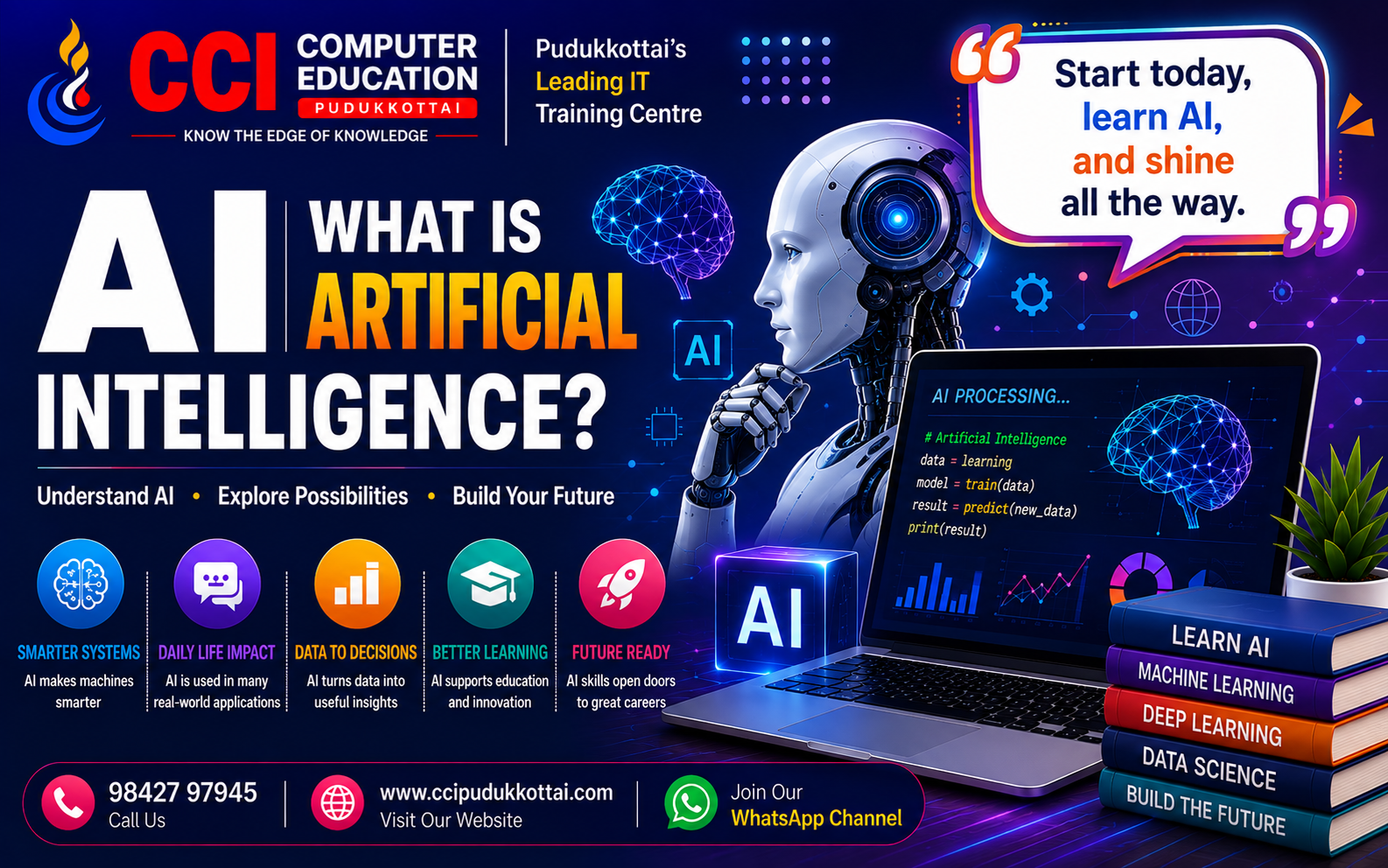
Artificial Intelligence, commonly called AI, is one of the most important technologies shaping the modern world. From voice assistants and recommendation systems to chatbots and smart applications, AI is becoming part of our everyday lives.
What is Artificial Intelligence?
Artificial Intelligence is a field of computer science that focuses on creating computer systems that can perform tasks that normally require human intelligence.
These tasks can include understanding language, recognizing images, learning from data, identifying patterns, making predictions, and supporting decision-making.
How Does AI Work?
AI systems generally work by processing information and identifying patterns in data. Depending on the application, an AI system may use algorithms, data, machine learning models, and computing power to produce useful results.
For example, when an AI system is trained using many examples of images, it can learn patterns that help it recognize objects in new images.
Examples of AI in Everyday Life
- Voice assistants and speech recognition
- Movie and music recommendations
- Online shopping recommendations
- Chatbots and virtual assistants
- Face and image recognition
- Navigation and route suggestions
- Fraud detection in banking
- Smart automation systems
AI in Education
AI is also changing the way students learn. AI-powered tools can help students understand difficult concepts, practice programming, generate ideas, and receive personalized learning support.
However, students should use AI as a learning assistant rather than simply copying answers. Understanding the concepts and practicing independently remain essential.
AI and Machine Learning
Machine Learning (ML) is an important area within Artificial Intelligence. Machine learning allows computers to learn patterns from data and improve their performance on specific tasks without being explicitly programmed for every individual situation.
AI Career Opportunities
The growth of AI has created opportunities across many technology fields. Students interested in AI can gradually learn programming, mathematics, data handling, machine learning, and problem-solving skills.
Some related career areas include:
- AI Developer
- Machine Learning Engineer
- Data Scientist
- AI Researcher
- Data Analyst
- Automation Developer
How Can Students Start Learning AI?
- Learn basic programming concepts.
- Start with Python programming.
- Understand mathematics and basic statistics.
- Learn how data is collected and processed.
- Study the fundamentals of Machine Learning.
- Build small practical projects.
- Gradually explore advanced AI technologies.
Why Should Students Learn About AI?
AI is becoming an important part of software development, business, education, healthcare, finance, automation, and many other industries. Learning the fundamentals early can help students understand how modern technology works and prepare for future opportunities.
Conclusion
Artificial Intelligence is more than just a popular technology. It is a major area of computer science that is changing how people work, learn, communicate, and solve problems.
Students do not need to learn everything about AI at once. Start with programming fundamentals, understand the basics, practice regularly, and gradually move toward Machine Learning and AI projects.
What's Next?
In our next AI learning guide, we will explore AI vs Machine Learning – What is the Difference? with simple real-world examples.
Call: 98427 97945 | Website: ccipudukkottai.com | WhatsApp Channel: Join Now
Share: Facebook | WhatsApp | Twitter