ExpenseFlow – Smart Expense Management System Using Java Spring Boot
Published: 02 Oct, 2026 | Author: CCI Admin | Category: Java / Spring Boot / Projects
Managing personal income and expenses using notebooks or spreadsheets can become difficult when the number of transactions increases. Users may find it hard to track their spending, manage monthly budgets, and understand where their money is being spent.
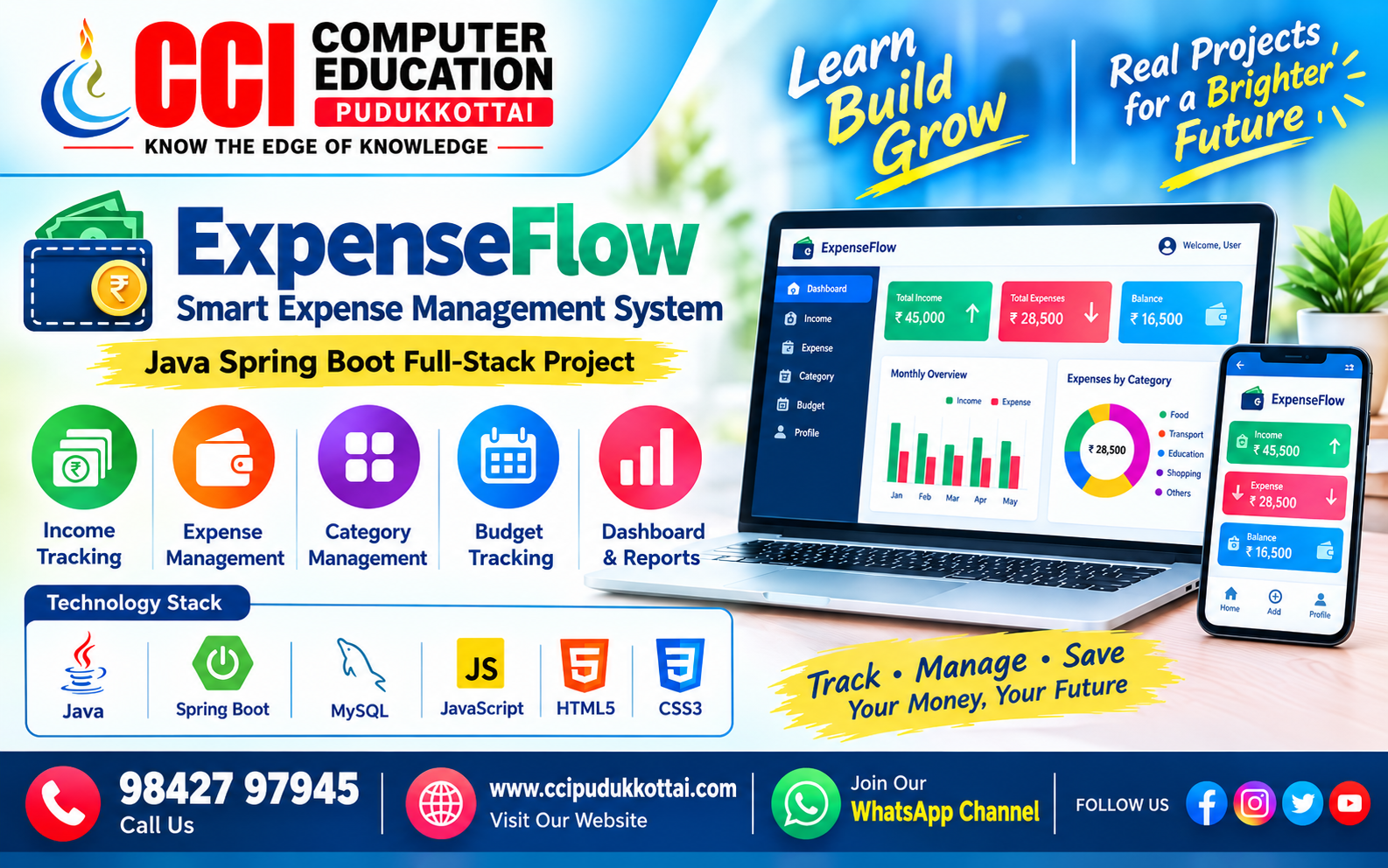
ExpenseFlow is a Smart Expense Management System designed to make income, expense, category, and budget management easier through a full-stack web application.
This project combines HTML, CSS, JavaScript, Java Spring Boot, REST APIs, Spring Data JPA, Hibernate, and MySQL to provide a structured expense tracking solution.
Project Presentation
Want to explore the complete project presentation? Click the button below to view the Employee Management System presentation.
What is ExpenseFlow?
ExpenseFlow is a Smart Expense Management System that allows users to manage their income and expenses online. The system provides a centralized dashboard where users can view financial information and monitor their budget.
The application also supports category-based expense management and monthly budget tracking, making it easier to understand spending patterns.
Why is an Expense Management System Needed?
Traditional methods such as notebooks and spreadsheets can create several difficulties when managing financial information.
- Manual recording of income and expenses.
- Difficulty tracking the current budget.
- No centralized financial dashboard.
- Possibility of missing or incorrectly recording transactions.
- Difficulty analyzing expenses by category.
Key Features of ExpenseFlow
ExpenseFlow provides several features for managing personal financial information.
- Online income and expense tracking.
- Category-based expense management.
- Monthly budget management.
- Real-time budget versus spending information.
- Centralized dashboard.
- MySQL database storage.
- Responsive web interface.
Technology Stack Used
| Technology | Purpose |
|---|---|
| HTML | Frontend page structure |
| CSS | Website styling and responsive design |
| JavaScript | Frontend interaction and API communication |
| Java | Backend programming |
| Spring Boot | Backend application development |
| Spring Data JPA | Database interaction |
| Hibernate | Object-relational mapping |
| MySQL | Data storage |
| REST API | Communication between frontend and backend |
ExpenseFlow Project Modules
The project is divided into different modules so that each part of the application has a specific responsibility.
| Module | Purpose |
|---|---|
| Home | Landing page of the application |
| Registration | Creates a new user account |
| Login | Allows users to log into the system |
| Dashboard | Displays income, expenses, balance and budget information |
| Income | Add, view and delete income records |
| Expense | Add, update, view and delete expenses |
| Category | Manage custom expense categories |
| Budget | Manage monthly budgets and spending |
| Profile | View and update user account details |
How ExpenseFlow Works
The basic workflow of the ExpenseFlow application can be understood as:
User Registration
        ↓
User Login
        ↓
Dashboard
        ↓
Income / Expense Management
        ↓
Category Management
        ↓
Monthly Budget
        ↓
Financial Summary
The frontend communicates with the Spring Boot backend through REST APIs. The backend processes the request and uses Spring Data JPA and Hibernate to communicate with the MySQL database.
Spring Boot Architecture
ExpenseFlow follows a layered application architecture. This separates the user interface, business logic, database operations, and data storage.
Frontend
HTML + CSS + JavaScript
        ↓
REST API
        ↓
Spring Boot
        ↓
Service Layer
        ↓
Repository Layer
        ↓
MySQL Database
The service layer handles business logic and validation, while the repository layer uses Spring Data JPA and Hibernate for database operations.
Database Design
ExpenseFlow uses MySQL for storing application data. The main entities include User, Expense, Income, Category and Budget.
| Entity | Important Data |
|---|---|
| User | ID, Name, Email, Password |
| Category | ID, Name, Description |
| Expense | ID, Amount, Description, Category, Payment Method, Date |
| Income | ID, Amount, Source, Description, Date |
| Budget | ID, Amount, Month, Year |
REST API Examples
The Spring Boot backend provides REST API endpoints for managing users, expenses, income, categories, budgets and dashboard information.
POST   /users
POST   /users/login

GET    /users/{id}
PUT    /users/{id}
DELETE /users/{id}

POST   /expenses
GET    /expenses
PUT    /expenses/{id}
DELETE /expenses/{id}

GET    /expenses/total
GET    /expenses/monthly

POST   /income
GET    /income
PUT    /income/{id}
DELETE /income/{id}

GET    /categories
POST   /categories

POST   /budgets
GET    /budgets

GET    /dashboard/summary
Practical Example – Monthly Expense Tracking
Suppose a user receives a monthly income and spends money on food, transportation, education and other categories.
The user can record the income in the Income module and add individual transactions through the Expense module. Expenses can then be organized using categories and compared with the monthly budget.
Monthly Income
      ↓
Record Income
      ↓
Add Expenses
      ↓
Select Categories
      ↓
Set Monthly Budget
      ↓
Compare Spending
      ↓
View Dashboard Summary
Budget Tracking
The Budget module allows users to maintain a monthly budget. The system provides information about the amount spent and the remaining budget.
This helps users understand their current spending position without manually calculating every transaction.
Dashboard
The dashboard provides a consolidated view of important financial information. It includes income, expenses, balance and budget-related information.
A centralized dashboard makes it easier for users to understand their financial information from one place.
Tools Used for Development
- Eclipse – Java development
- Maven – Project and dependency management
- MySQL Workbench – Database management
- Postman – REST API testing
- Git – Version control
Common Challenges in Expense Management
- Managing many financial transactions manually.
- Tracking expenses by category.
- Comparing spending with a monthly budget.
- Maintaining financial data in one place.
- Creating a system that can be accessed through a responsive web interface.
Faculty Tip
ExpenseFlow is a useful project for students who want to understand how a full-stack Java application works. Students can study the complete flow from frontend pages to REST APIs, Spring Boot services, repositories and MySQL database operations.
Practice Task for Students
Students can study the ExpenseFlow project and try the following activities:
- Create a simple Spring Boot project.
- Create an Expense entity.
- Connect the project with MySQL.
- Create REST APIs for expenses.
- Test the APIs using Postman.
- Create a simple frontend for adding expenses.
Frequently Asked Questions
1. What is ExpenseFlow?
ExpenseFlow is a Smart Expense Management System for managing income, expenses, categories and monthly budgets through a web application.
2. Which backend technology is used?
The backend is developed using Java Spring Boot.
3. Which database is used in ExpenseFlow?
ExpenseFlow uses MySQL for storing application data.
4. Does the project use REST APIs?
Yes. REST APIs are used to connect the frontend with the Spring Boot backend and manage users, expenses, income, categories, budgets and dashboard information.
5. Which technologies are used for the frontend?
The frontend uses HTML, CSS and JavaScript.
6. Is ExpenseFlow suitable as a student project?
Yes. The project demonstrates several important full-stack development concepts including Spring Boot, REST APIs, Spring Data JPA, Hibernate, MySQL and frontend development.
Future Enhancements
The project documentation identifies several possible future improvements for ExpenseFlow.
- JWT authentication and password hashing.
- PDF and Excel financial reports.
- Receipt scanning.
- Budget alerts.
- Multi-currency support.
- Mobile application.
Why Learn This Project?
ExpenseFlow demonstrates how different technologies can work together to create a complete full-stack application.
By studying this project, students can understand the relationship between frontend development, REST APIs, Java Spring Boot, service layers, repositories, JPA, Hibernate and MySQL.
Conclusion
ExpenseFlow is a Smart Expense Management System that brings income, expense, category and budget management together in a single web application.
The project demonstrates practical full-stack development using Java Spring Boot, MySQL, REST APIs, Spring Data JPA, Hibernate, HTML, CSS and JavaScript.
Projects like ExpenseFlow help students move from learning individual programming concepts to understanding how a real-world full-stack application is designed and developed.
Related CCI Blogs
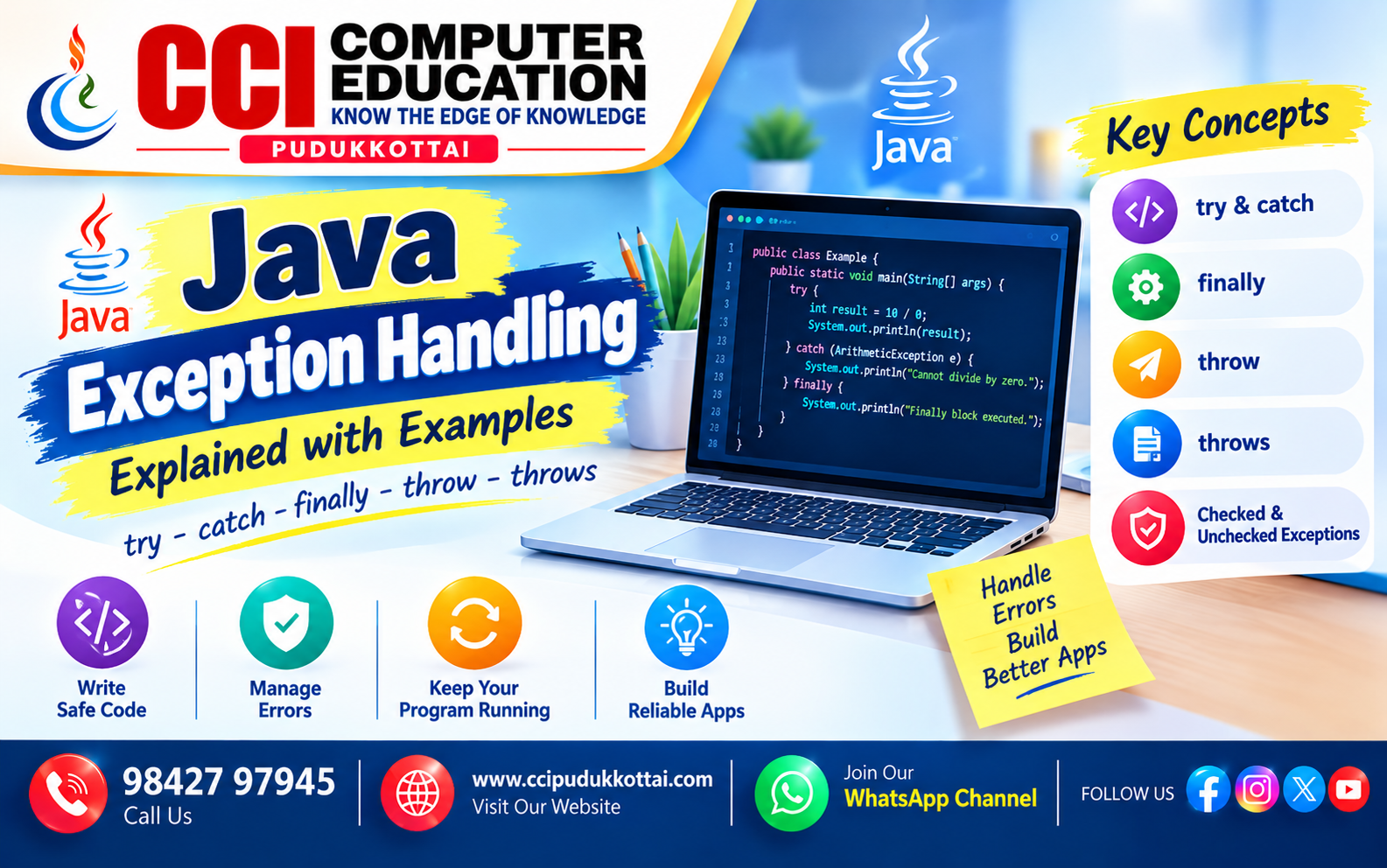
- Java Classes and Objects – Learn Object-Oriented Programming with Simple Examples
- Introduction to MySQL – Database Fundamentals
- Basic SQL Queries – SELECT, WHERE and ORDER BY
Contact CCI Computer Education – Pudukkottai
Want to learn Java, Spring Boot, MySQL and Full Stack Development?
Call: 98427 97945 | Website: ccipudukkottai.com
WhatsApp Channel: Join Now
Share: Facebook | WhatsApp | Twitter