C++ Classes and Objects Explained with Examples
Published: 23 Sep, 2026 | Author: CCI Admin | Category: C++ / Programming
Classes and objects are important concepts in C++ Object-Oriented Programming (OOP). They help programmers organize data and functions together and represent real-world entities in software applications.
In this tutorial, we will learn what a class and object are, how to create them, how to access class members, and how they are used in real-world applications.
What is a Class in C++?
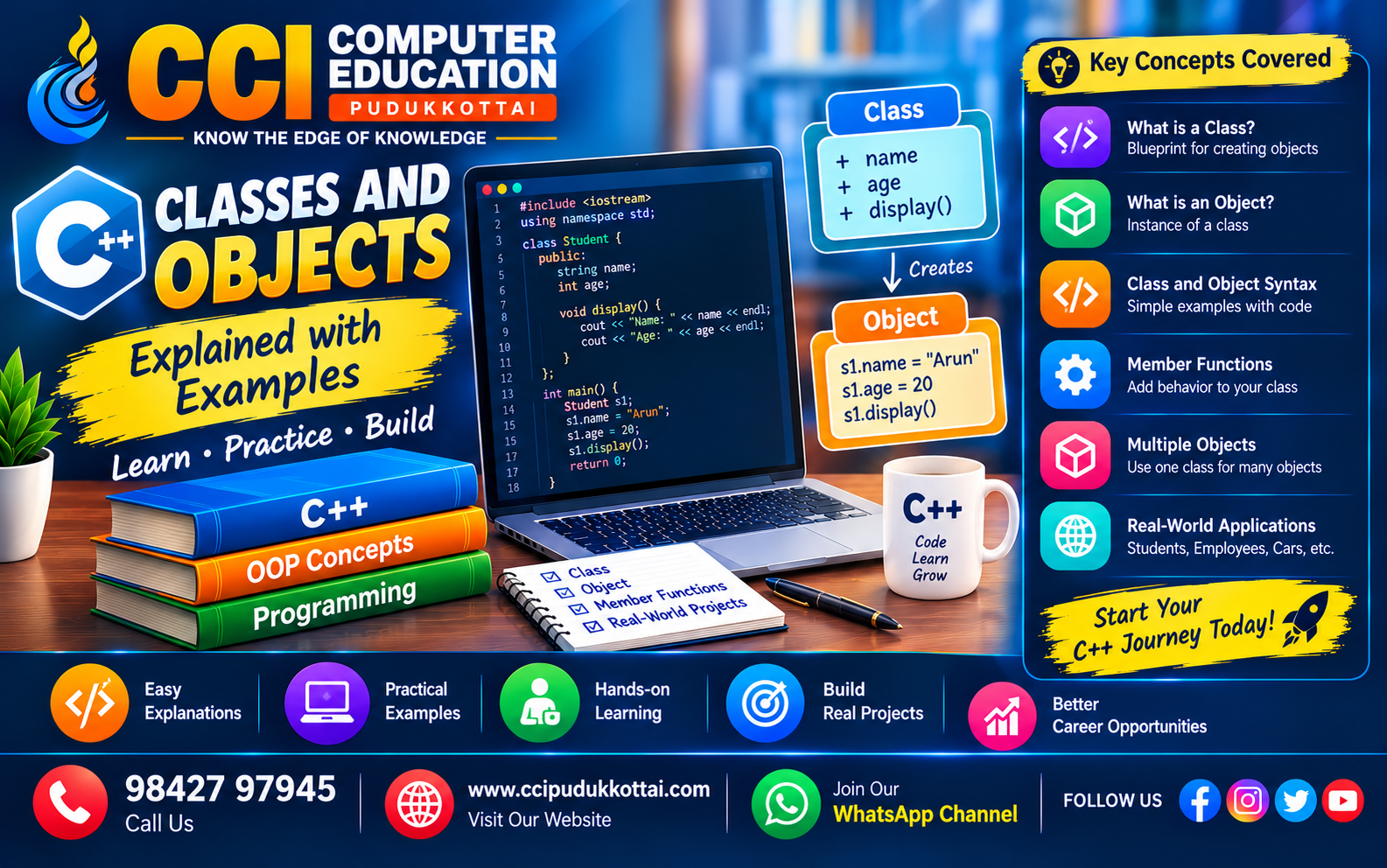
A class is a blueprint or template used to create objects. It can contain variables, commonly called data members, and functions, commonly called member functions.
class Student {

public:
    string name;
    int age;

};
Here, Student is a class containing two data members: name and age.
What is an Object in C++?
An object is an instance of a class. After creating a class, we can create multiple objects from it.
Student student1;Here, student1 is an object of the Student class.
Simple Class and Object Example
#include <iostream>
using namespace std;

class Student {

public:
    string name;
    int age;

};

int main() {

    Student s1;

    s1.name = "Arun";
    s1.age = 20;

    cout << "Name: " << s1.name << endl;
    cout << "Age: " << s1.age << endl;

    return 0;
}
In this example, Student is the class and s1 is the object. The dot operator is used to access the members of the object.
Understanding the Code
- class Student – Creates a class named Student.
- string name – Stores the student's name.
- int age – Stores the student's age.
- Student s1 – Creates an object named s1.
- s1.name – Accesses the name of the object.
- s1.age – Accesses the age of the object.
Creating Multiple Objects
One class can be used to create multiple objects. Each object can contain different values.
Student student1;
Student student2;

student1.name = "Arun";
student1.age = 20;

student2.name = "Priya";
student2.age = 21;
Both objects belong to the same class, but they contain different student information.
Classes with Member Functions
A class can contain functions that define the behavior of its objects.
#include <iostream>
using namespace std;

class Student {

public:
    string name;

    void display() {
        cout << "Student Name: " << name << endl;
    }

};

int main() {

    Student s1;

    s1.name = "Arun";
    s1.display();

    return 0;
}
The display() function is a member function of the Student class. The object s1 is used to call the function.
Class and Object – Simple Comparison
| Class | Object |
|---|---|
| Blueprint or template | Instance of a class |
| Defines data and functions | Uses the class members |
| Example: Student | Example: student1 |
Real-World Example
Classes and objects can be used to represent real-world entities in applications.
- Student
- Employee
- Bank Account
- Car
- Product
- Customer
For example, an Employee Management System can have an Employee class with properties such as employee name, employee ID, department, and salary.
class Employee {

public:
    string name;
    int employeeId;
    double salary;

};
Why Are Classes and Objects Important?
- They help organize large programs.
- They improve code reusability.
- They represent real-world entities.
- They make applications easier to maintain.
- They are the foundation of C++ OOP.
- They help developers build structured applications.
Common Mistakes Beginners Make
- Forgetting the semicolon after a class definition.
- Trying to access private members directly.
- Confusing a class with an object.
- Forgetting to create an object before accessing members.
- Using incorrect member access syntax.
Practice Task for Students
Create a C++ class called Car with the following properties:
- Brand
- Model
- Price
Create two objects and assign different values to each object. Then display the details using a member function called display().
Frequently Asked Questions
1. What is a class in C++?
A class is a blueprint that defines data members and member functions for objects.
2. What is an object in C++?
An object is an instance of a class. It is used to access the members defined inside the class.
3. Can one class have multiple objects?
Yes. A single class can be used to create multiple objects with different data values.
4. How do we access class members?
Public members can generally be accessed using the dot . operator.
student1.name;
student1.display();
5. Why are classes and objects used in C++?
They help organize programs, improve code reusability, and model real-world entities using Object-Oriented Programming.
Learn C++ Through Practical Training
At CCI Computer Education, Pudukkottai, students can learn C++ programming through simple explanations, coding exercises, OOP concepts, and practical projects.
Students can start with C++ fundamentals and gradually learn classes, objects, constructors, inheritance, polymorphism, encapsulation, abstraction, and real-world application development.
Conclusion
Classes and objects are the foundation of Object-Oriented Programming in C++. A class provides the structure, while objects are created from that structure to represent individual entities.
Once you understand classes and objects, you can move forward to important C++ OOP concepts such as constructors, inheritance, polymorphism, encapsulation, and abstraction.
What's Next?
In the next C++ tutorial, we can explore Constructors in C++ and learn how constructors are used to initialize objects.
Related CCI Blogs
Contact CCI Computer Education – Pudukkottai
Want to improve your programming and IT skills? Join CCI Computer Education, Pudukkottai and learn through practical, step-by-step training.
Call: 98427 97945 | Website: ccipudukkottai.com | WhatsApp Channel: Join Now
Share: Facebook | WhatsApp | Twitter