How to Become a Software Developer – A Step-by-Step Career Guide
Software development is one of the most popular career paths in the IT industry. Software developers create websites, mobile applications, desktop software, business applications, and many other technology solutions.
If you are a student or beginner wondering how to start a career as a software developer, you do not need to learn every technology at once. Start with the fundamentals, practice consistently, and gradually build real projects.
What Does a Software Developer Do?
A software developer designs, writes, tests, maintains, and improves software applications. Developers work with programming languages, databases, development tools, APIs, frameworks, and version-control systems.
Step 1: Learn the Fundamentals
Start by understanding basic programming concepts before moving to advanced technologies.
- Variables and data types
- Operators
- Conditions
- Loops
- Functions
- Arrays and collections
- Object-Oriented Programming
- Error handling
Step 2: Choose a Programming Language
Beginners can start with one programming language and become comfortable with its fundamentals. Popular choices include:
- Python
- Java
- C++
- C#
- JavaScript
The important thing is not to learn many languages at the same time. Choose one language, practice regularly, and understand programming concepts deeply.
Step 3: Learn Database Basics
Most real-world applications need to store and retrieve information. Learning database concepts is therefore an important part of becoming a software developer.
Start with:
- SQL basics
- Tables and records
- Primary keys
- Relationships
- SELECT, INSERT, UPDATE and DELETE
- MySQL or another relational database
Step 4: Learn Web Development
If you are interested in web application development, learn the basic technologies used to create websites and web applications.
- HTML – Structure of webpages
- CSS – Styling and layout
- JavaScript – Interactivity and browser-side logic
- Backend technology – Server-side application logic
- Database – Storing application information
Step 5: Learn Git and GitHub
Version control is an important skill for modern software development. Git helps developers track changes in their code and work with other developers.
Beginners should learn how to create repositories, commit changes, create branches, and push projects to GitHub.
Step 6: Build Real Projects
Reading programming concepts is useful, but building projects helps you understand how those concepts work together.
Beginners can start with:
- Calculator
- Student Management System
- Attendance Management System
- To-Do List
- Online Registration System
- Simple E-commerce Website
- Portfolio Website
Step 7: Practice Problem Solving
Software development is not only about knowing programming syntax. Developers need to understand problems, break them into smaller tasks, and create logical solutions.
Practice small coding problems regularly using conditions, loops, functions, arrays, strings, and other programming concepts.
Step 8: Learn Testing and Debugging
Errors are a normal part of programming. A good developer learns how to read error messages, identify the cause of a problem, test the program, and fix bugs.
Step 9: Create a Strong Portfolio
Your portfolio can demonstrate what you are capable of building. Include your best projects and explain the technologies and features used in each project.
A beginner portfolio can include:
- About Me
- Technical Skills
- Projects
- Education
- Certifications
- GitHub profile
- Contact information
Step 10: Prepare for Interviews
Before applying for software developer jobs, revise programming fundamentals, Object-Oriented Programming, SQL, basic data structures, project concepts, and problem-solving questions.
Also practice explaining your own projects clearly. Interviewers may ask why you selected a technology, how your application works, and how you solved problems during development.
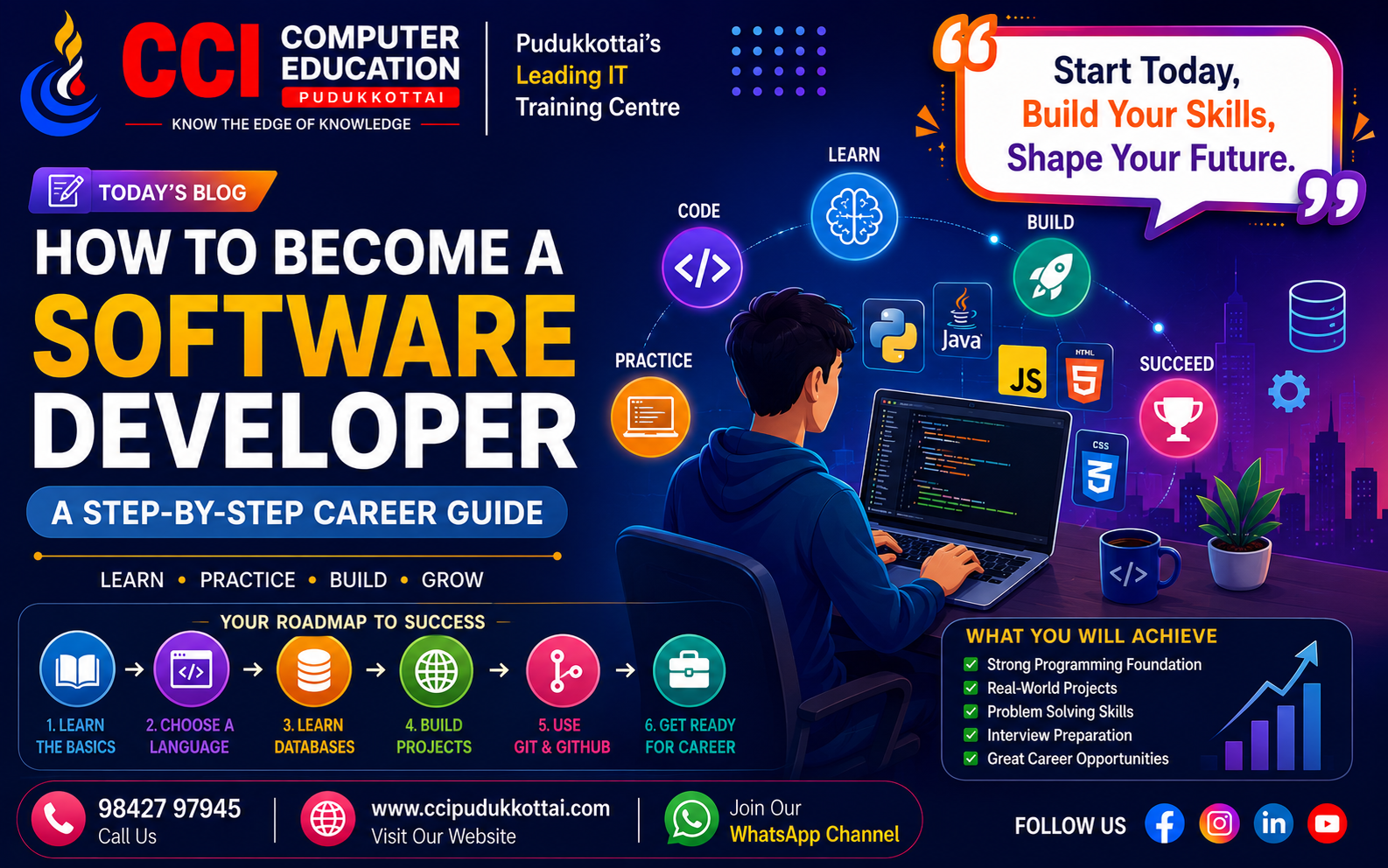
A Simple Learning Roadmap
A beginner-friendly roadmap can look like this:
Programming Fundamentals → OOP → SQL → Git/GitHub → Web Development or Application Development → Projects → Testing → Portfolio → Interview Preparation → Job
Important Tips for Beginners
- Do not try to learn every technology at once.
- Choose one clear career direction.
- Practice coding regularly.
- Build projects instead of only watching tutorials.
- Learn from your errors.
- Keep your projects on GitHub.
- Improve your communication skills.
- Keep learning as technology changes.
Learn Through Practical Training
If you are looking to build your IT skills in Pudukkottai, CCI Computer Education can help you begin your learning journey with practical computer education, programming training, and project-based learning.
Conclusion
Becoming a software developer is a step-by-step journey. You do not need to master everything in a single day. Choose a programming language, learn the fundamentals, practice regularly, build projects, and continuously improve your technical and communication skills.
Consistent learning and practical experience can make a strong difference when preparing for a software development career.
What's Next?
In our next career guide, we will explore How to Build a Strong Resume for an IT Career and the important sections every student and beginner should include.
Call: 98427 97945 | Website: ccipudukkottai.com | WhatsApp Channel: Join Now
Share: Facebook | WhatsApp | Twitter